What AI Is Revealing About Garden Design
Every few weeks, somebody asks us whether AI is going to replace garden designers.
It's an understandable question. AI can now generate remarkably convincing garden images in a matter of seconds and, depending on which corner of the internet you find yourself in, you could be forgiven for thinking that every creative profession is about to be transformed overnight.
What has been interesting is watching how quickly the conversation has shifted. A year ago, most discussions about AI were really quite speculative. Now it's appearing in design studios, international practices and classrooms, and students are understandably trying to work out what that means for their future.
The more we've discussed AI within the profession, however, the less we think this conversation is really about technology. In fact, if anything, AI has simply forced us to have a conversation that probably should have been happening anyway: what is it that garden designers actually bring to a project?
If the role of a garden designer is simply to produce attractive images, then AI does look like a threat. But anyone who has spent time designing gardens knows that the image is often the least interesting part of the process.
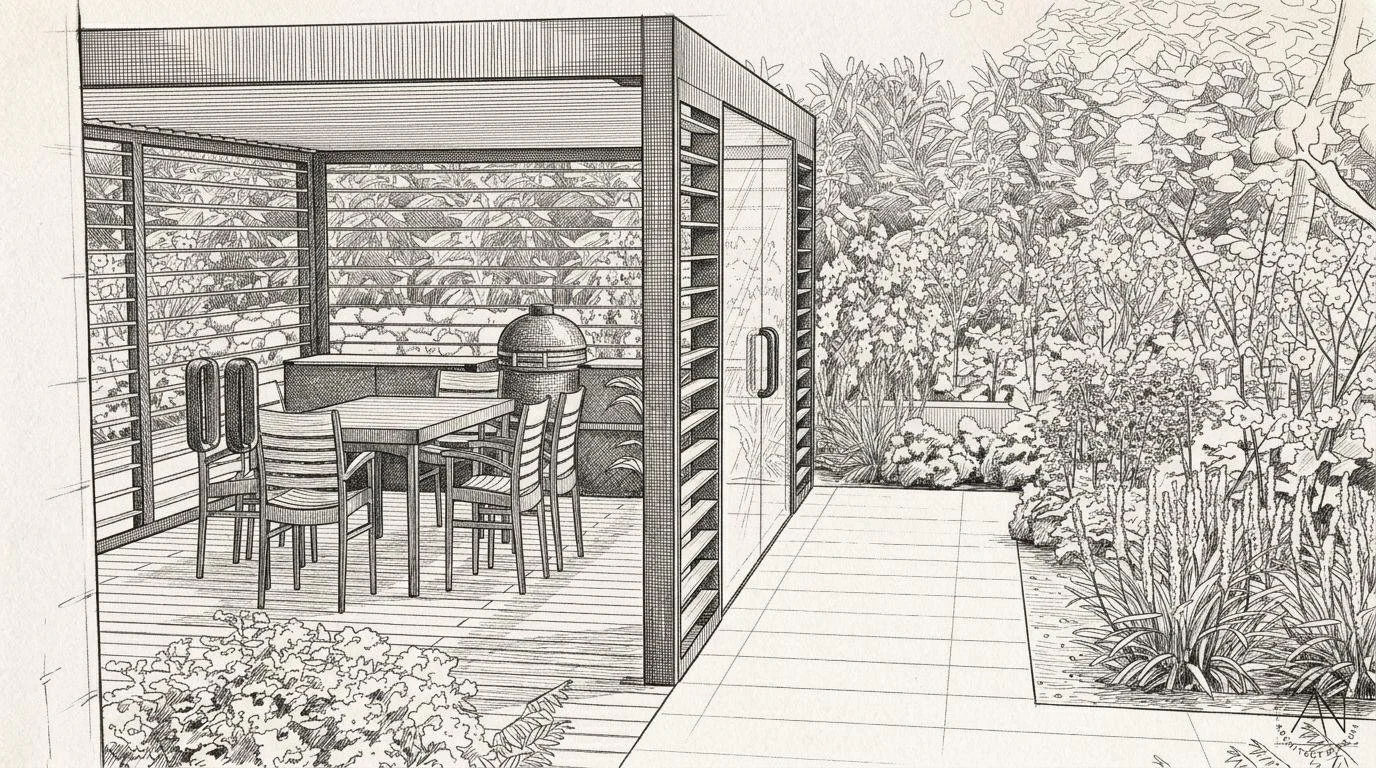
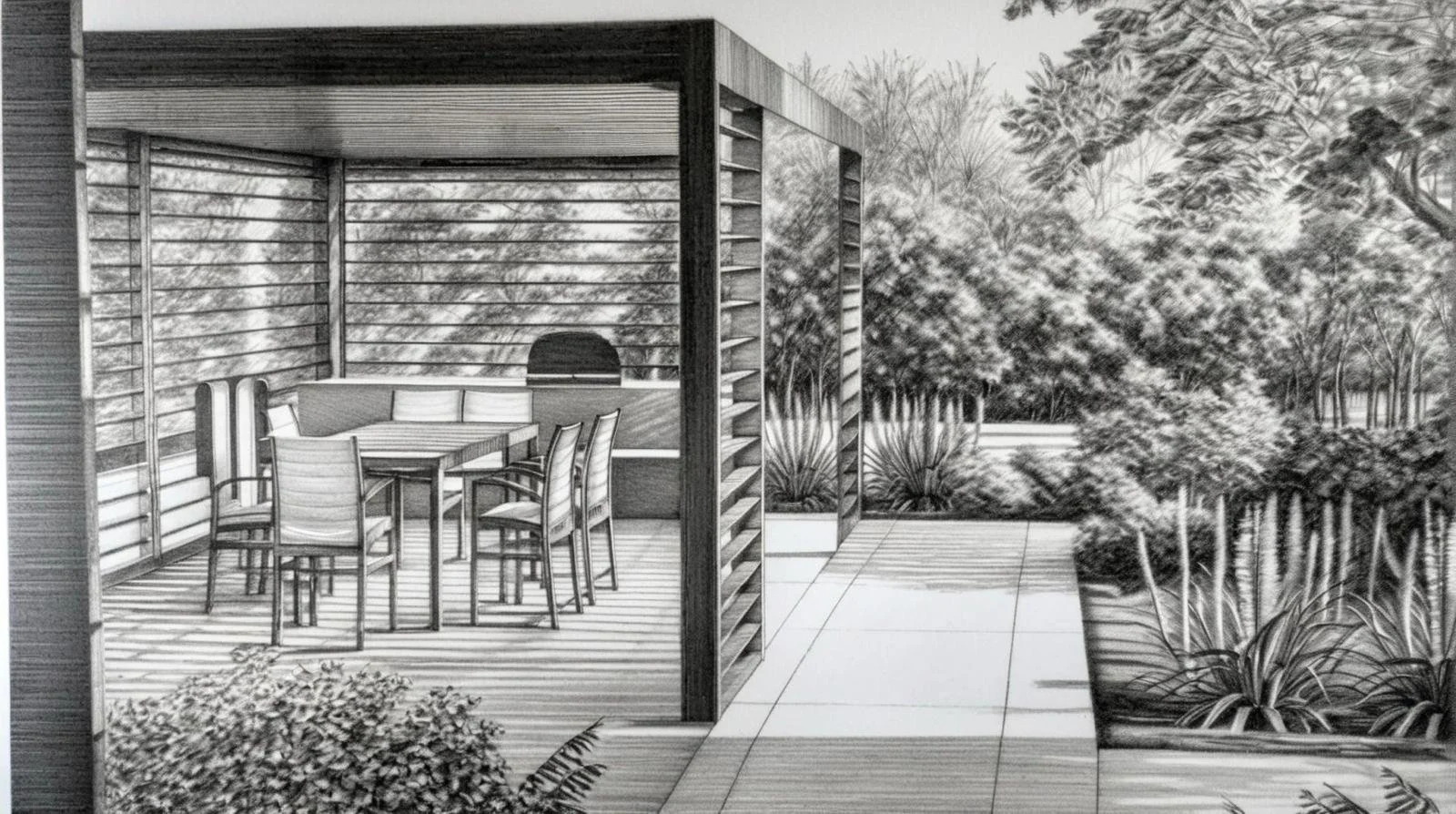


Images courtesy of Fisher Tomlin & Bowyer
A garden is not a render. It isn't a mood board. It isn't even the plan set that eventually gets issued for construction. A garden is a response to a place, to the people who will live in it and to a future that doesn't exist yet.
Some of the most important design decisions are made before a concept plan has even been sketched. They happen while walking a site and noticing where winter sunlight falls. They happen while listening to a client describe how they want to feel when they're sitting outside with a coffee on a Sunday morning. They happen while observing details that rarely make it into a brief but often become the foundation of a successful project.
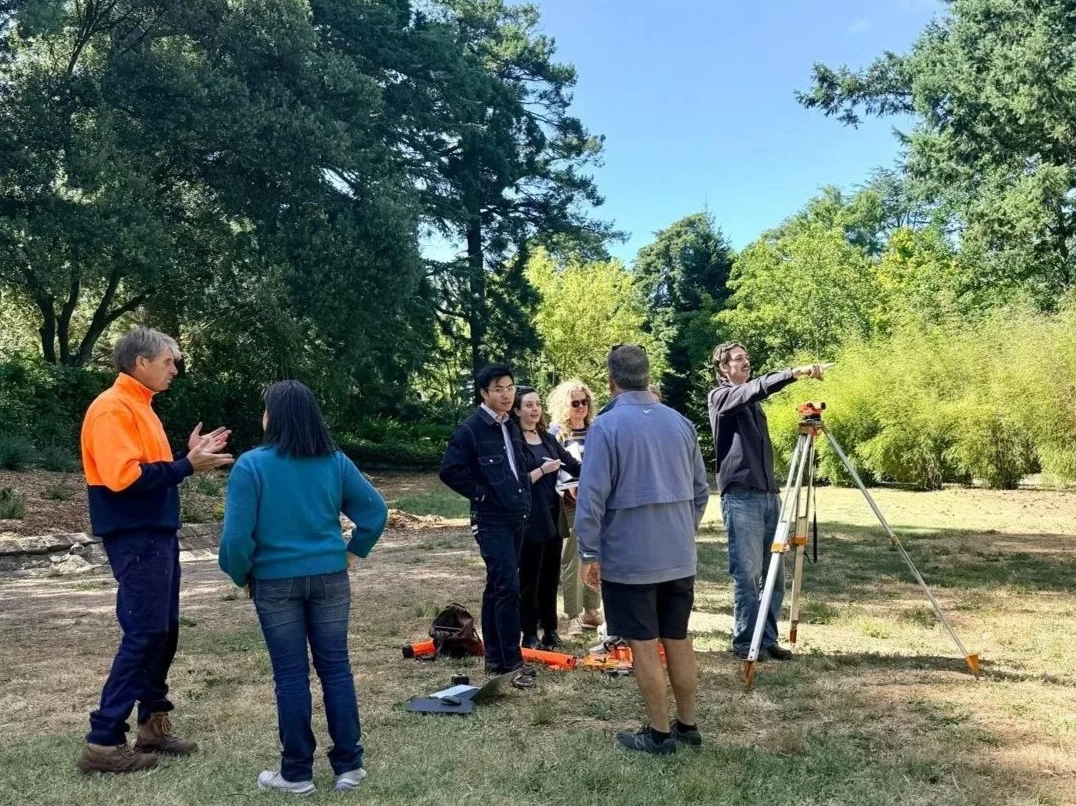
LCGD Students and Alumni at an onsite briefing of the Kyneton Bontanic Gardens, welcome garden
Those things are difficult to automate because they rely on observation, experience and human understanding, which is perhaps why the rise of AI has prompted such an interesting discussion within our industry. More than anything, it has forced us to think more carefully about which parts of design are genuinely irreplaceable.
For Brent Reid, Director of LCGD Australia and principal of Candeo Design, the answer starts with understanding the difference between a compelling image and a successful design.
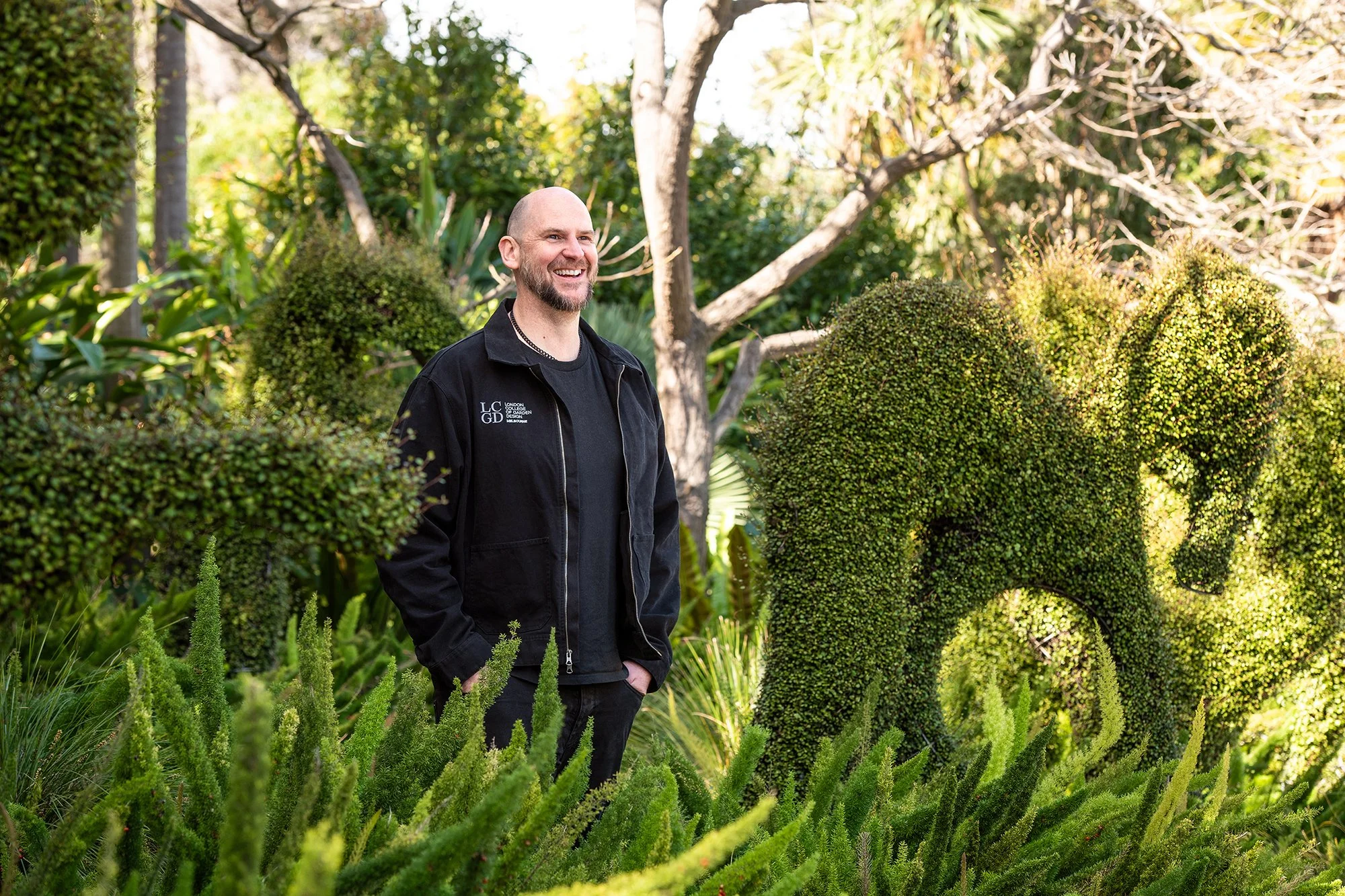
"Having spent 30 years in the industry, I have a pretty clear understanding of where experience is irreplaceable and where good tools can genuinely help. What I'm starting to see sometimes is a temptation to use AI to generate visual ideas before the designer has truly understood the site, the client or the brief.
The image looks convincing. But the thinking underneath it isn't there yet.
It's a bit like a retaining wall without the correct footing or drainage. It might look fine at first, but the cracks will appear at some point.
What I keep coming back to is that AI works beautifully as a support to strong design thinking. It doesn't work as a substitute for it."
Most clients don't engage a garden designer because they want an image. They engage a designer because they want someone to make decisions. Hundreds of them. Decisions about layout, circulation, materials, levels, planting, privacy, maintenance, scale, atmosphere and how all of those things work together.
Those decisions are informed by experience, observation and judgement; the ability to recognise when an idea works, the confidence to know when it doesn't, and the restraint to leave something out rather than adding more.
Those qualities have always separated good designers from great ones, and there is nothing particularly new about that.
Andrew Fisher Tomlin, co-founder of Fisher Tomlin & Bowyer and Director of LCGD, believes AI is helping to shine a light on exactly this distinction.

"One of the things I find most interesting about AI is that it encourages us to think more carefully about what is uniquely human in the design process, especially our ability to think creatively.
Garden design has never been just about producing drawings. Drawings are simply how we communicate imagination and ideas. The real work lies in understanding people, understanding place and imagining possibilities that don't yet exist.
Used thoughtfully, AI may actually create more space for designers to focus on those things. That seems to me to be an opportunity rather than a threat."
In his recent book, The Modern Professional Planting Designer, Andrew explores the idea that planting design is fundamentally concerned with time. Designers are constantly making decisions about what a landscape might become in five, ten or twenty years. They are imagining growth, succession, maturity and change long before any of it happens.
That kind of thinking isn't really about information. It's about imagination.
Creativity is often spoken about as though it's a moment of inspiration, but most designers know it usually arrives through a much messier process. Through testing ideas, changing your mind, revisiting a site, having conversations and slowly developing a response that feels right. AI may become part of that process, but it doesn't replace it. And while AI can be remarkably effective at generating possibilities, it still relies on someone to decide which possibilities are worth pursuing.
This becomes especially important in education.
One of the genuine challenges presented by AI is that it can create the illusion of competence. A student can generate something that looks resolved without necessarily understanding why it works, whether it works or what compromises might be hidden beneath the surface.
That isn't an argument against students learning to use AI. Far from it. The profession is already using these tools and tomorrow's designers will need to understand them.
The question is not whether students should use AI. It's how and when.
Students at LCGD Australia learn to draw before relying on software. They develop planting knowledge before reaching for visualisation tools. They learn how to read a site, communicate ideas and think critically before introducing technology that can accelerate the process.
The foundations come first because the foundations are what make every tool useful.
As Brent puts it:
"The designers I see who use AI really well are the ones who could do the work without it. That is not a coincidence.
When you have genuine skill and experience, AI becomes an efficient way of doing your job, testing ideas faster and communicating more clearly with clients. When you don't have those foundations, it becomes a way of producing things that look finished before the thinking is done. The output looks similar. The quality isn't."
While most discussions about AI eventually circle back to creativity and productivity, Andrew believes there is another consideration that deserves far more attention.
Most discussions about AI focus on creativity, productivity and innovation. Less attention is given to the environmental cost of the technology itself.
As someone deeply involved in environmental design, Andrew believes this is a conversation our profession should be engaging with more openly.
"Because of the environmental impact on energy and water use, in my own office we use AI sparingly. Until that impact can be resolved, such as through recycling the water used in AI data centres, the danger is that we use AI unnecessarily and have a detrimental impact on our planet."
It's a perspective that won't be universally shared, but it is one that is increasingly being discussed throughout the design profession. For landscape designers, gardeners and environmental professionals whose work is often centred around improving environmental outcomes, the resource demands of AI raise questions that are difficult to ignore. Which is another reason why simplistic conversations about AI tend to miss the point.
The question has never really been whether technology is good or bad. The more useful question is how we use it.
Every generation of designers has adopted new tools. Hand drafting gave way to CAD. Three-dimensional modelling changed how projects were presented. Visualisation software transformed client communication.
Each shift altered the profession in some way, but none of them removed the need for creativity, judgement or design thinking. If anything, those qualities became more valuable.
We suspect the same will prove true of AI, which is probably the most encouraging part of this discussion.
The more sophisticated these tools become, the more valuable the distinctly human parts of the design process seem to become. The ability to listen carefully, to observe, to imagine, to exercise judgement.
None of those things feel any less important today than they did five years ago. If anything, they feel more important.
AI will continue to evolve, and so it should. Every generation of designers has adapted to new technology. What hasn't changed is the need for thoughtful people who can understand a place, recognise its potential and imagine what it might become.
If anything, that's what this whole conversation has reminded us of.